California's first CCA-driven virtual power plant to integrate a large-scale managed EV charging program using OpenADR 3.1, now scaling across MCE's territory with ev.energy
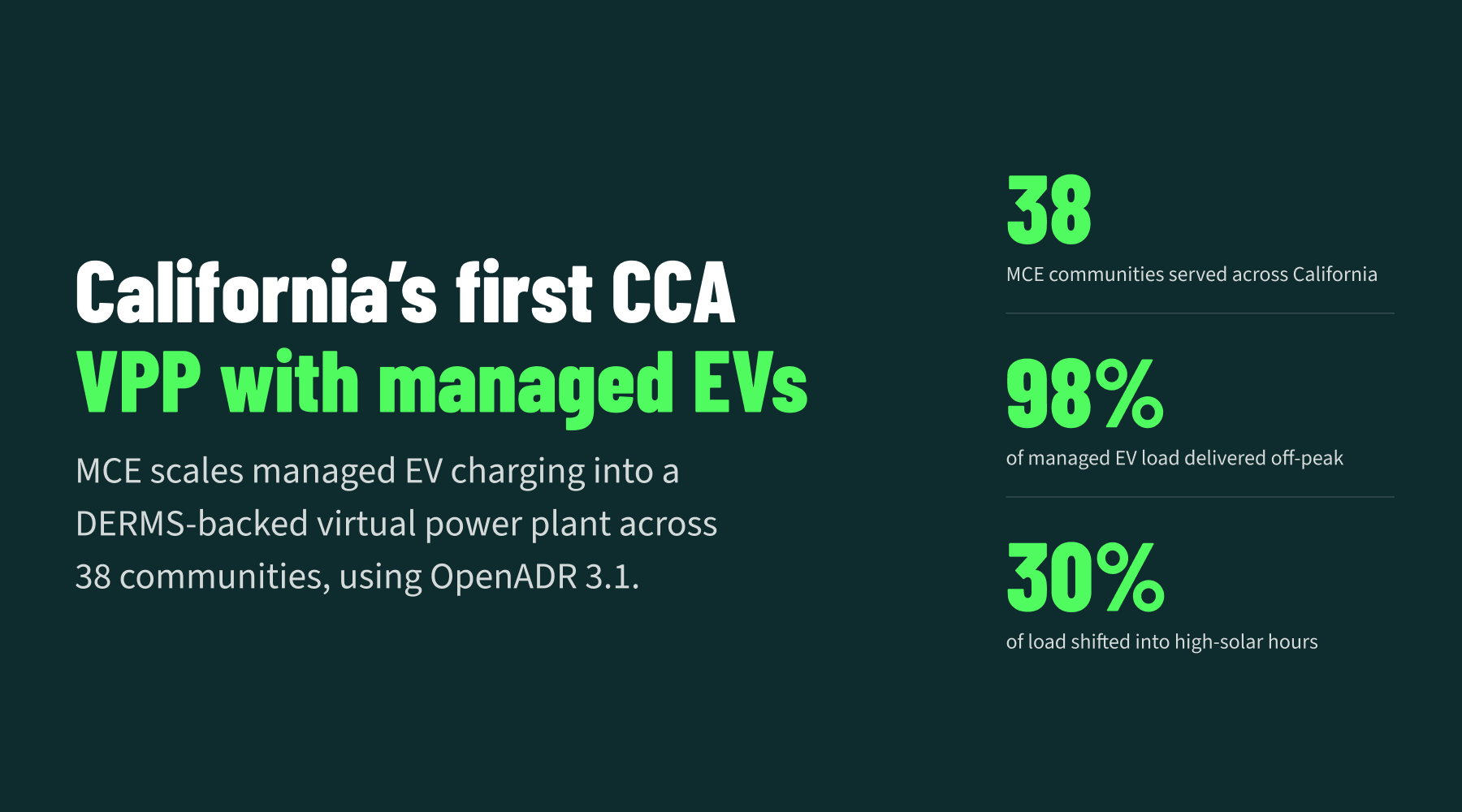


The first California CCA program to use OpenADR 3.1 to connect a managed EV charging platform into a DERMS-backed VPP that informs CAISO market bids.
California electricity rates are among the highest in the country, and they're rising faster than inflation. For community choice aggregator (CCA) MCE and the 38 communities it serves, that pressure is the context for an ambitious bet: the first CCA-driven virtual power plant in California to integrate a large-scale managed EV charging program using OpenADR 3.x, now scaling beyond its Richmond pilot across MCE's territory.
Demand-side management is one of the more promising tools for addressing energy affordability. By coordinating the flexible loads customers already own — EV chargers, home batteries, solar — energy providers can reduce wholesale procurement costs and generate revenue in energy markets. MCE returns that value to its communities through downward pressure on electricity rates rather than capturing it as profit.
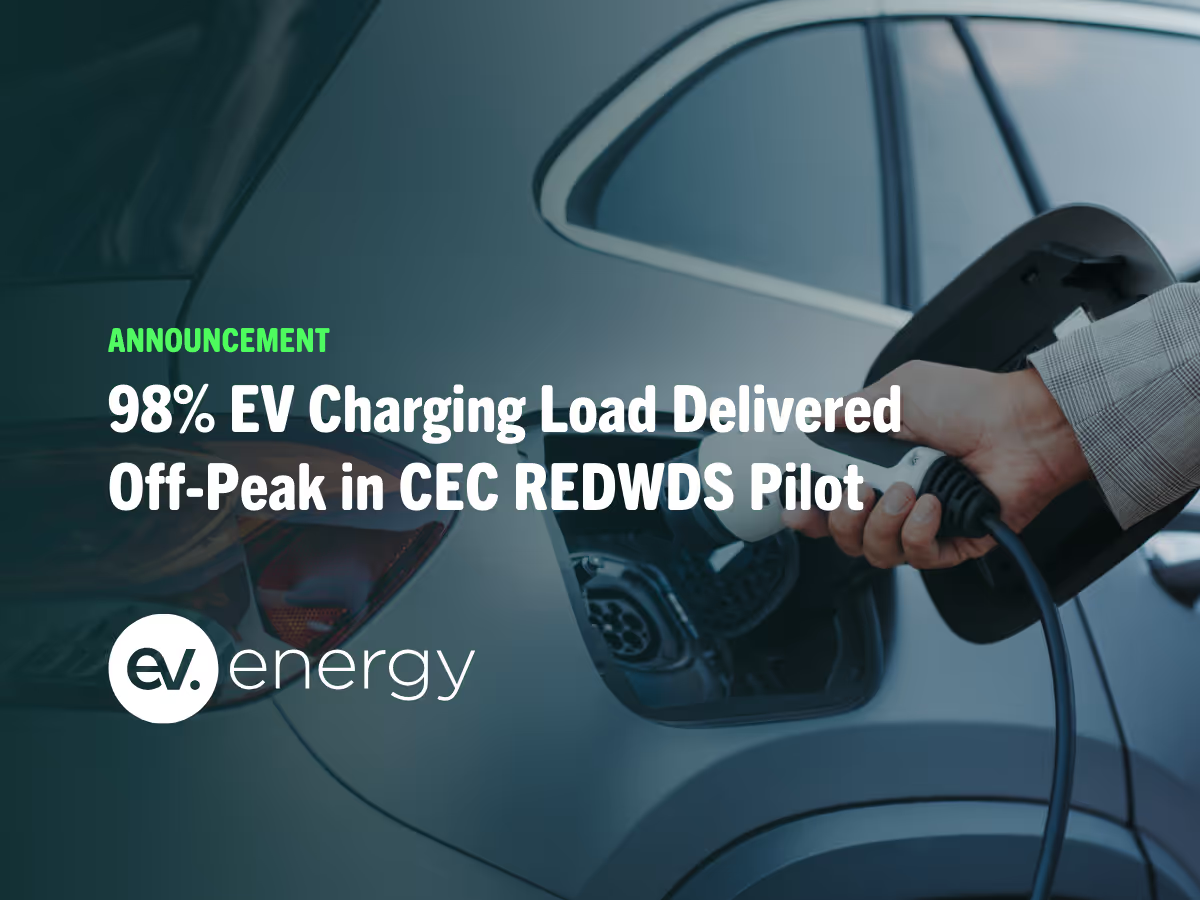
For years, ev.energy and MCE have run an award-winning managed EV charging program, MCE Sync, delivering 98% of load off-peak and shifting 30% of load to times of high solar generation. The 2026 AESP Energy Award for Innovation in Technology recognised that work earlier this year. Now, VPP integration takes EVs in the program from off-peak load shifters to active grid assets — contributing to wholesale market participation, balancing alongside renewable ramping, and offering distribution-level benefits.
This week at the CalCCA Conference, MCE and ev.energy discussed how open standards enabled the integration of MCE Sync into MCE's CEC-funded VPP Flex programme. The integration connects ev.energy's platform to the Serious Controls DERMS using OpenADR 3.1, with enrolled vehicles streaming real-time telemetry to MCE's energy coordination layer for load forecasting and CAISO market scheduling with active dispatch to come.
The rate pressure problem
When a utility or CCA participates in wholesale energy markets, the accuracy of its load forecasts affects the prices it pays. Committing to a level of demand reduction and then delivering it consistently unlocks capacity revenue. Delivering it unreliably erodes that value.
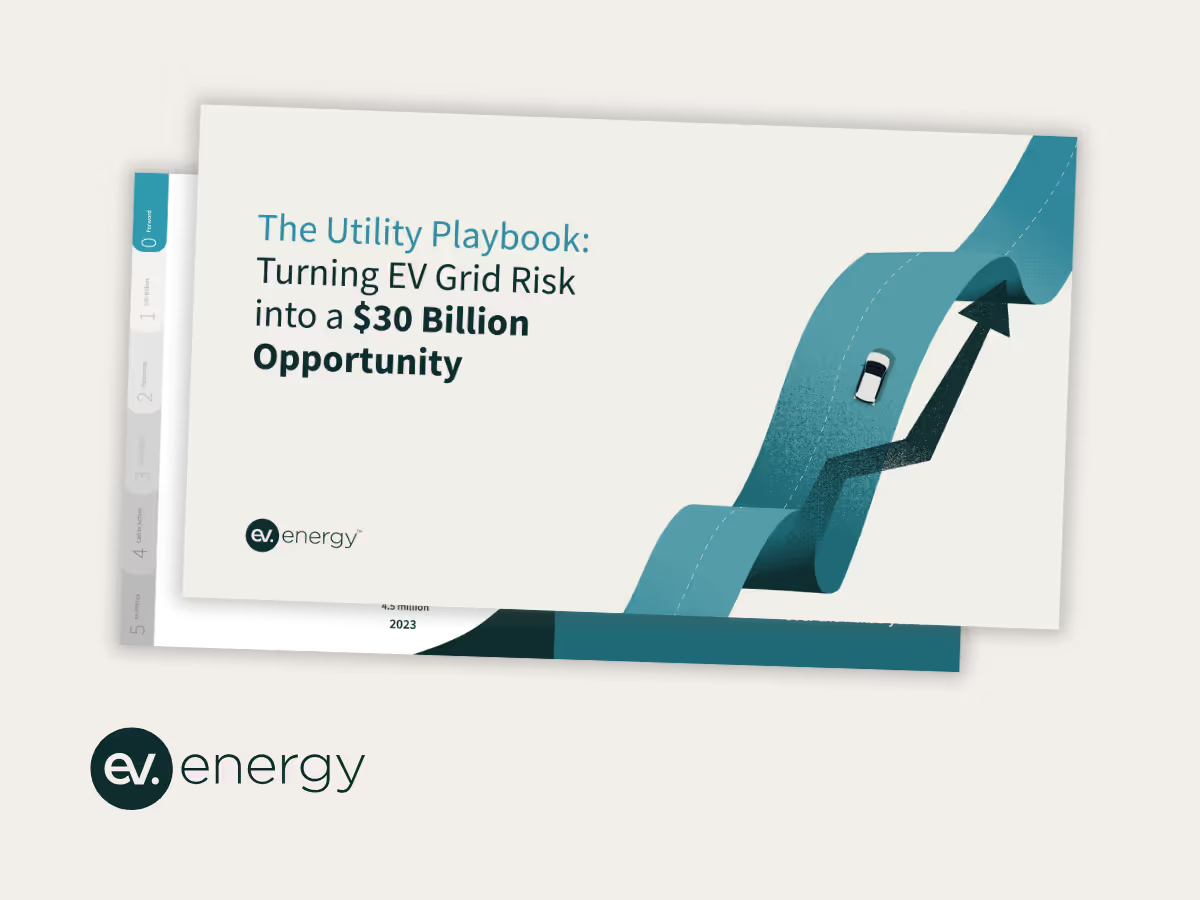
“Our analysis has shown that managed EV charging can deliver $30 billion in grid value–but this requires connecting them to market participation,” said Nick Woolley, CEO, ev.energy. “Bringing EVs into VPPs makes it possible to realize the full value stack of managed charging, and doing so with open standards offers a scalable approach for all CCAs. With this standards-based integration, MCE has real-time visibility into EV load across its territory, enabling more granular load flexibility and more accurate CAISO bids, supporting better cost outcomes across MCE's 38 communities. We’re proud to help scale EVs into VPPs across MCE communities in California.”
EVs are a natural starting point for this kind of integration. A home EV charger draws up to 11 kW — more than all other household load combined. Vehicles spend most of their plugged-in time with plenty of charge headroom, which means their charging can be shifted or shaped without affecting driver readiness. We recently covered the difference between nameplate capacity and shiftable load for a variety of DERs. EVs have a large shiftable load, so they’re a strong foundation for any VPP and can deliver a meaningful amount of dispatchable flexibility. And according to the California Energy Commission (CEC), EVs actually represent the largest flexible load available in California: 18.5 GW, more than battery storage.
Why an open protocol choice matters for scaling VPPs
The open integration is built on OpenADR 3.1, connecting ev.energy's platform to the Serious Controls DERMS running the VPP. That technical decision has practical consequences for how quickly the VPP model can expand.
Many managed charging programs and VPP integrations use proprietary protocols. Proprietary works well enough when one vendor controls both sides of the connection. It becomes a bottleneck when a CCA wants to bring in a second DER provider, add home batteries, or eventually integrate V2X-capable vehicles–or when one proprietary provider changes the terms of the integration.
OpenADR removes that friction. Any DER provider that supports the standard can connect to a VPP without building an integration from scratch. MCE's intent is to expand the platform across additional device types and additional providers. ev.energy is the first integration partner to help scale MCE’s load flexibility program beyond its original Richmond pilot. The open standard means subsequent integrations won't face the same development burden.
For CCAs across California, that matters because most face similar constraints: limited internal technical resources, regulatory pressure to demonstrate program cost-effectiveness, and communities where electricity affordability is a primary concern. A VPP built on open standards means the cost and complexity of adding the next integration doesn't fall entirely on the CCA or the incoming provider. That's a meaningful difference from a model where every new device type or vendor requires negotiating a proprietary connection.
What comes next
MCE's VPP is now scaling to all 38 communities it serves in 2026, supported by CEC funding. Active dispatch of enrolled EVs is the next capability milestone. MCE is also seeking additional DER integrations to expand what VPP Flex can coordinate. Summer solicitations are open for providers interested in joining the platform.

About ev.energy
ev.energy exists to connect everyone to cleaner, cheaper, simpler energy—managing the world’s distributed energy resources, everywhere. Through its Platform, ev.energy provides a scalable, inclusive, and proven platform that turns electric vehicles, solar, and batteries into flexible grid assets, unlocking real value for energy providers, consumers, and the planet. With a global base of utility and OEM partners, ev.energy is the leading force in multi-asset DER orchestration. Learn more at https://www.ev.energy/.
MCE received CEC funding to scale its load flexibility program. MCE and ev.energy’s MCE Sync managed charging program was recognized with the 2026 AESP Energy Award for Innovation in Technology.



.png)
.png)

.avif)
.avif)


.avif)


.avif)




.avif)


