Beyond the EV: How Integrated DERs are Defining the Future of Energy Flexibility Globally
.png)


Nick Woolley, CEO & Co-Founder of ev.energy, reflects on industry convergence, 2025 momentum, and the path forward for DER orchestration.
As 2025 draws to a close, the pace of the energy transition has reached a critical velocity. For years, we’ve talked about the ‘electrification of everything’ as a long-term goal. This year, it became an urgent operational reality.
On one side, global EV sales are accelerating beyond forecasts, on track to exceed 20 million units this year (up 25% year-on-year), representing one in four cars sold worldwide. On the other side, the grid is screaming for help.
The fundamental shift I’ve observed is that nobody in the energy industry can afford to view electric vehicles, solar, or home batteries as siloed assets anymore. Leading utilities and retailers now see them as essential, coordinated components of a single, massive resource: the residential Virtual Power Plant (VPP). The industry conversation has moved from 'Can we manage the EV load?' to 'How do we orchestrate all Distributed Energy Resources (DERs) to provide firm, reliable capacity?' That change defines ev.energy's strategic response.
Proving VPP Value and Accelerating Scale in 2025
My personal highlight for 2025 has to be the groundbreaking work we did on quantifying the value of smart charging.
The Managed Charging Cost-Avoidance Framework we published this year—with research support from The Brattle Group—established the definitive business case for mass deployment. We proved that smart charging isn't just a compliance exercise or customer benefit; it's a financial imperative. The report confirmed that managed EV charging can unlock up to $30 billion in annual utility cost avoidance by 2035 across the U.S. This validation of managed charging's value, endorsed by respected industry economists, felt like a watershed moment for our entire sector. This value is central to our mission and ensures we deliver tangible benefits for everyone: potential long-term benefits for consumers, including a 10% reduction in average U.S. household energy bills, and a core metric of delivering up to $575 in annual avoided costs per actively managed EV.
Our commitment to value is precisely why we lead the market. Wood Mackenzie recognized us as the #1 provider of EV-centric managed charging deployments in North America for the second year running, a recognition based on the sheer number and scale of our operational programs with utility clients across the US.
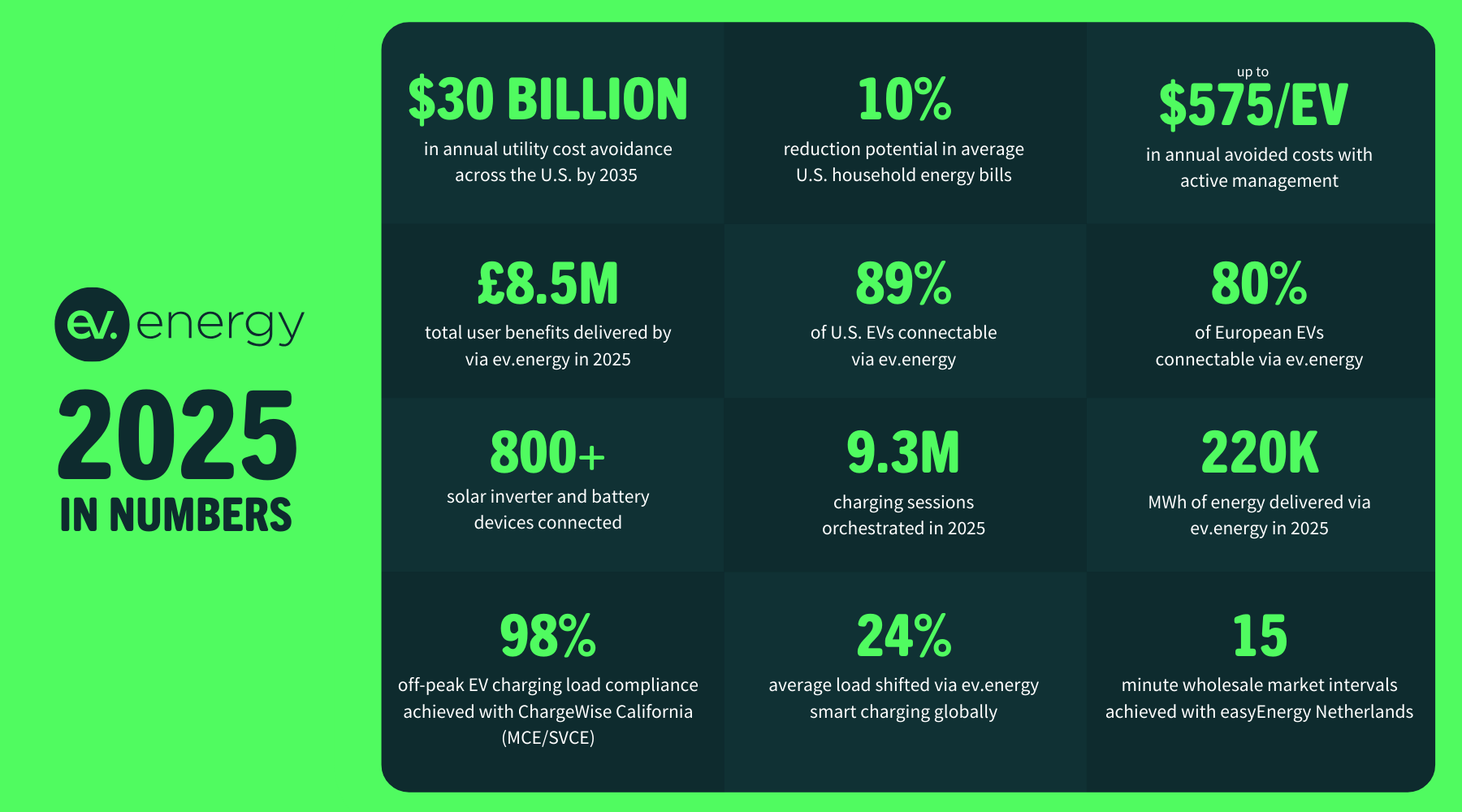
In 2025 alone, our platform saw immense growth, orchestrating 9.3M charging sessions and delivering 220K MWh of energy. These results are underpinned by a 24% average load shifted via smart charging, delivering tangible financial impact for end-consumers: £3.0M in direct smart charging savings and £5.5M in incentives paid out by our clients, totalling £8.5M in user benefits this year, all while removing hundreds of tonnes of CO₂e.
Additionally, we expanded the EV capacity of our platform by integrating with JLR, Zaptec, EO, Hypervolt, and more to come via our partnership with Volteras. We’re also seeing a real appetite for V2X. Being selected for a $12m program from the U.S. Department of Energy (DOE) was a fantastic validation of the deployment of our advanced managed charging capabilities at scale. We expect vehicle-to-grid to become a substantial grid resource by 2035, more than doubling the per-vehicle value we can unlock.
Utilities and Retailers Face Extraordinary Change
Our job is to anticipate and solve our clients’ most pressing operational challenges. As we look at North American utilities and European energy retailers, we see three converging pressures forcing them to act decisively:
1. Unprecedented Load Growth: In North America, the five-year peak load forecasts have increased nearly sevenfold since 2022. The explosion of data centre demand—projected to consume up to 12% of US electricity by 2028—has fundamentally accelerated the timeline for grid transformation. Europe faces similar load growth. Utilities must now shift from viewing managed charging as a customer perk to seeing it as their most effective, low-cost asset for grid reliability.
2. Regulatory Alignment and Interoperability: This push for flexibility is reflected in regulations globally. In North America, 47 US states took grid modernisation actions in Q1 2025 alone, pushing for VPP approvals. In Europe, the EU Data Act became applicable in September 2025, forcing device manufacturers and energy companies to grant universal access to consumer device data. The need to be hardware-agnostic and support an interoperable smart energy ecosystem has been a long-held belief at ev.energy. We call this philosophy the Open Charge approach, and it’s why we offer our clients unmatched market coverage, allowing utilities to instantly connect to over 85%+ of EVs in the U.S. and 80%+ in Europe and orchestrate EV charging reliably. Additionally, the UK’s implementation of P415 late last year was a landmark moment; for the first time, independent aggregators gained access to UK wholesale electricity markets, enabling Virtual Lead Parties (including ev.energy) to unlock the full value of distributed flexibility this year.
3. The Retailer Imperative: As competition becomes fiercer among retailers, the model of selling and trading electricity alone is no longer sustainable. Retailers who fail to adapt face existential risk. For us, the opportunity is clear: Retailers are sitting on a vast, unactivated VPP. The biggest hurdle in building a VPP is acquiring assets. Retailers already own the customer relationship, meaning they can activate their existing DERs—EVs, solar, and batteries—and get a significant head start. We’re proud to deliver the orchestration layer that enables our retailer clients to activate and optimize these assets, unlock additional grid service revenue streams across multiple energy markets, and offer that market-winning, all-in-one home energy management proposition. This is key to acquiring and retaining customers as they adopt EVs and DERs. Our work with ANWB Energie in the Netherlands is a prime example: their innovative dynamic tariffs actually paid drivers to charge during periods of abundant renewable energy, turning smart charging into a customer acquisition and retention tool.
Orchestrating the Full Energy Ecosystem
Our heritage is in smart EV charging, but the clear market demand for firm capacity meant 2025 was the right time to formalise our move into multi-asset DER orchestration, integrating home batteries and solar optimisation.
An EV alone provides tremendous flexibility, but when you coordinate it with a home battery and solar production, the value compounds exponentially. It becomes a VPP resource that can deliver firm, scheduled capacity, which is what utilities need to defer expensive infrastructure upgrades and soak up cheap, clean renewable energy.
This expansion is about four critical pillars for our clients in 2026:
- Value Stacking: We enable our clients to coordinate behind-the-meter load management to access multiple revenue streams simultaneously—from wholesale market participation to local distribution-level peak reduction.
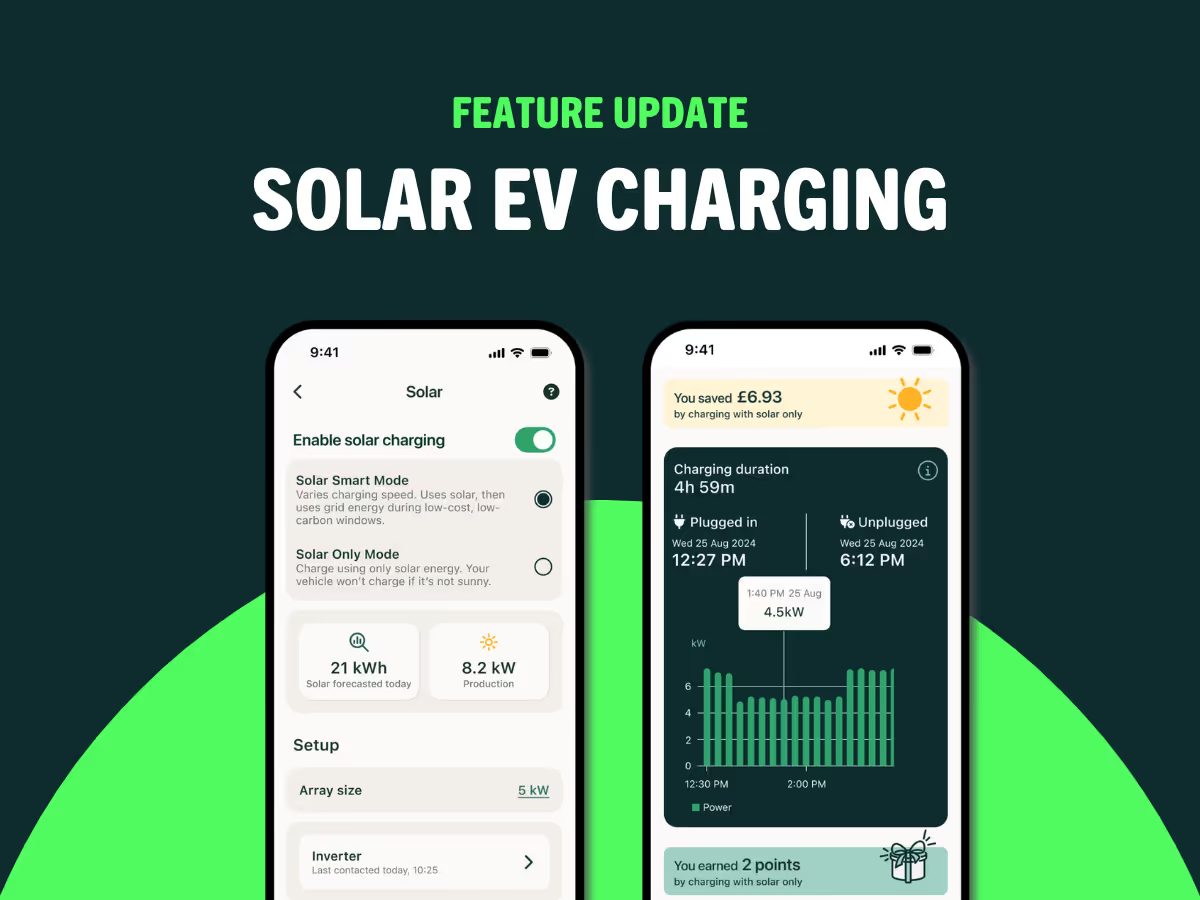
- Unmatched Coverage: Building on our core strength in EV and EV charger integrations, we are rapidly expanding our full-home coverage. Our platform already has connections to over 800 inverters and batteries from 19 brands, including Enphase, SolarEdge, Tesla Powerwall, and Growatt. We've been optimising for solar since 2022, and now, with home battery integration, we complete the picture.
- Pilot-to-Scale Confidence: It is time to move beyond scale-scale pilots. Our CEC-backed ChargeWise California pilot with MCE and SVCE is just one example proving programs can deliver scale, equity and impact simultaneously. The program achieved 98% EV charging load off-peak with a “rate add-on” approach that enrolled 1,000+ customers in 2 months, over 50% of whom are living in disadvantaged communities. We also demonstrated how to effectively match EV load to clean energy, shifting 45%
of daytime charging to periods of abundant solar in California. - AI Investment: We cannot close out 2025 without mentioning AI. The explosion of data centre demand—projected to consume up to 12% of US electricity by 2028—has fundamentally accelerated the timeline for grid transformation. But here's the thing: this is actually a good development for our industry. AI-driven load growth is forcing our customers, the energy companies, to confront a simple truth: we cannot build our way out of this with traditional infrastructure alone. Together, we must electrify faster, think differently, and embrace Virtual Power Plants to plug the capacity gap. The urgency AI creates is precisely what's needed to move flexibility from pilot programmes to core grid strategy. That's why we're embracing AI in the tools we deliver to our customers too—using machine learning to improve forecasting, optimize dispatch, and enhance the customer experience. The same technology driving electricity demand is helping us manage it more intelligently.
This is the blueprint for the resilient, decarbonised grid of tomorrow, and it’s why we’re accelerating deployments across everything from DTE's Multi-Unit Dwelling pilot in Michigan to new 15-minute wholesale market integration with easyEnergy in the Netherlands. You can expect more from us on all three of these critical pillars in the coming months.
Let’s Win Together in 2026
My message is simple: We're ready to build the future grid, together.
2025 was about proving mass-scale value. 2026 will be about unlocking it in practice. We're investing heavily in the tools that ensure equity and resilience, expanding our multi-asset VPP capabilities, and continuing to champion the Open Charge approach.
We believe the next era of the energy transition won’t be won by closed, fragmented systems, but by open, intelligent orchestration. We have the data, the technology, the scale, and the proven partnerships to accelerate this transition.
Thank you to all our clients and partners for the confidence you place in us. We’re proud to work together to secure an affordable, reliable, and sustainable energy future for every grid customer. Onwards!
%20(1).png)

















.avif)


